Last Saturday, I went to babysit two kids I had never met before: a 5-year-old girl and a 7-year-old boy. Before I could even properly step inside—with my shoes and jacket still completely soaked from the rain—the little girl ran up to me, bursting with excitement to show me her new doll. She told me it was a "magic doll" because "it can really disappear and do magic tricks." "But seriously, for real, for real!" she said. I believed her instantly.
After her mom showed me around and explained their bedtime routine, both the parents and the kids told me that they had celebrated the girl's birthday earlier that day, and that’s when she had received the "magic doll" as a gift. It came with a storybook, and the kids asked if I would read it to them later that evening. (Which I was more than happy to do, because literally anything is better than watching Disney+ for an hour and a half!)
Once the parents left, we decided to put Disney+ on pause and read the book together. But as enthusiastic as the girl was at the beginning of the book, she was just as terrified by the end of it. Seriously, she suddenly became absolutely petrified of that doll. Now, admittedly, I didn't think it was a very nice story either. It claimed that the elf (the book was called The Elf on the Shelf—which, according to my best friend, is a massive social media phenomenon) is always watching the kids to report everything back to Santa, and that you are never, ever supposed to touch it, but just let it sit on a shelf. Of course, the moment I read that part out loud, the little girl was holding the doll. She panicked so badly that she dropped it instantly and refused to even look at it. Even though I tried to calm her down and compared it to Sinterklaas (a traditional Dutch and Belgian winter festival featuring a benevolent saint and his helpers, whom she wasn't afraid of at all, but actually really excited about!), it was no use. The poor kid was terrified, shaking, and starting to cry. We decided to put the doll back in its box, close it tight, and leave it in the kitchen. That seemed to help her, and after she watched a little more Disney+, I thought she was over it.
But once bedtime rolled around, the fear came right back. She kept repeating that the doll would come into her room and hurt her. I tried to soothe her by reassuring her that I would keep a constant eye on the box and protect her, and that I would tell her mom and dad all about it later that night so they could take over. I promised her the doll couldn't do anything to her and swore she was safe. But it was no use; she was way too scared to even hear me. She brushed her teeth with tears streaming down her face and a runny nose (honestly, my heart just broke for her!). She was shaking all over, and getting into bed was an absolute nightmare for her. I asked what I could do to help or comfort her, but she couldn't really find the words. Finally, her brother told her, "I'm scared too, but I'm being brave, and I will protect you" (which was honestly the sweetest thing ever!).
The kids were in bed by 8:30 PM, but at 10:30 PM, they both suddenly came back downstairs. The girl had had a nightmare about "the creepy doll," woke up her brother, and dragged him downstairs with her, hoping to find some comfort. She was disappointed to see me instead of her mom and dad, and of course, I couldn't blame her. When you have a nightmare at that age, you only want your parents, not a stranger babysitting you. But here is the crazy part: that kid was drenched. She had sweated so much from pure terror that I could literally wring out her pajamas! I asked her parents about it afterward, and apparently, nothing like this had ever happened before; they had never experienced anything like it.
It’s a striking story, isn't it? That little girl was scared to death of a silly doll. As an adult, it's easy to see how unnecessary that fear is, but to that child, the danger was incredibly real. She had built up that doll and the magical powers she and her cousins had given it earlier that day into such a reality that she completely believed it. To her, it wasn’t a plush toy; it was a threat. The danger was real, the fear was real. No amount of comfort or rational reasoning could undo it. Her amygdala took over before her rational brain even had a say in the matter. Adrenaline and cortisol were pumping through her system, gearing her up to flee from what she perceived as a life-threatening situation.
As adults, it’s easy to dismiss this as childish behavior or irrational fears, but I deliberately choose not to do that in this blog post. Because how different are we, really? Or better yet: how different am I? Not that different, if I’m being completely honest.
You wouldn't believe how much time I spend every single day (and night) overthinking, worrying, and over-analyzing future situations to death. Not just minutes, but hours and hours and hours a day. In my head, I rehearse conversations and scenarios that haven't even happened yet, playing them out in dozens of different ways until I've prepared the "perfect" script. My response, yours, my counter-response, and so on. And all of this with just one goal: emotional safety. If I can anticipate, plan, and prepare for it in advance, I hope to make it through that future situation as unscathed as possible. Yet we all know—myself included—that most of those conversations never actually happen in real life. And when they do, they usually go entirely differently than we ever could have predicted. Preparing for future worst-case scenarios is such an unbelievable waste of time and energy, and yet we keep doing it. (Yes, "we," because I know for a fact I’m not the only one!)
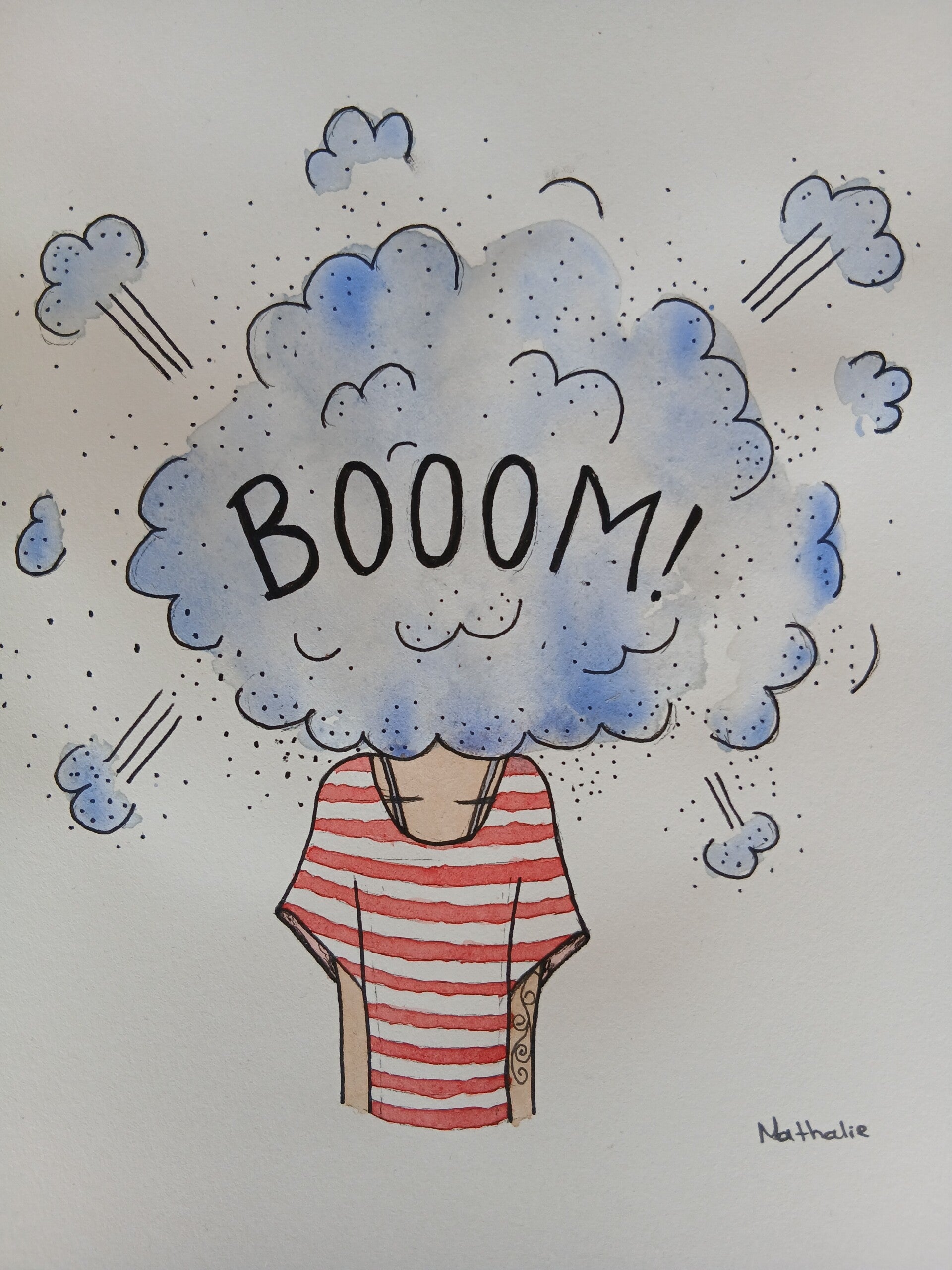
Yesterday, I tried to draw how I feel during and after one of those overthinking sessions, and honestly, it turned out pretty accurate. My head feels like it's exploding, and I don't know up from down anymore. In those moments, the only thing I need is to decompress—meditation, quiet time, time with God. But meditating often makes it even worse; it just makes me feel more lost in the rabbit hole that is my own mind. So what do you do? What's the move?
The Bible says "to take every thought captive to make it obedient to Christ." Incredible advice. Seriously. There's just one thing: I feel like I'm already doing that. It's mind-boggling how often I hand everything over to God in prayer, all day long, yet still manage to get lost in my own head. Someone I know once compared it to giving someone gifts and then immediately asking for them back—you just don't do that, right? Yet that’s exactly what I do: I hand over my anxiety, and then immediately snatch it back to try and control the situation myself. "If I'm in control, everything will go exactly the way I need it to," the thought goes. Except, what I think I need isn't always what I actually need. By letting go of control, by putting the future in God's hands, I can actually do His will, and the situation will unfold the way it's supposed to—even if the outcome is completely different from what I expected. Stressing out about it in advance is completely pointless.
But I already know all of this. So how do I stop my mind when it feels like a pressure cooker that's about to blow?
But I already know all of this. So how do I stop my mind when it feels like a pressure cooker that's about to blow?
By distracting myself, apparently. By praying, handing it over to God, sharing it with someone else (talking out loud to someone else really does help), and then feeding my mind a completely different diet. A few years ago, when I was new in recovery, that's exactly how I used to do it. Somewhere along the way, I clearly unlearned that habit. I used to think books or podcasts would overwhelm my mind too quickly, but ultimately, my own thoughts do that anyway. So why not feed myself something more constructive than my own doom-loop scenarios? Over the last few days, I’ve started listening to Bible and twelve-step podcasts again, and the effect was noticeable: less anxiety, fewer alarm bells in my head, and more peace in my body. I don't want to overstimulate myself, but I don't have to: listening to something like Psalms for Sleep while painting seems to work wonders without causing sensory overload.
And now, by putting this into words, I hope I won't forget it again. I hope that from now on, I’ll handle it more constructively. Because reflecting on things that have passed, looking back at my day, and neatly processing everything in my soul and body is something I find incredibly valuable—and absolutely necessary for recovery. I have no doubt about that, and it's a healthy habit I will definitely keep. But grabbing hold of every possible future scenario right now and over-analyzing them to death, when I still can't predict the future anyway, makes absolutely no sense. It only makes me anxious, and nothing ever happens the way I "prepared" for it anyway. So, I’d much rather just let go and let God, right?
And, because recovery is allowed to be fun sometimes too, I’d love to share a Pinterest pin I stumbled across a few days ago. It made me laugh out loud, purely because it was so incredibly relatable!

Reacties
Reactie plaatsen